January 28, 2012
????????????
It is not about the links, or love for music, or getting something for free, or whathever reason sick minds have, it is about diversity of cultural heritage of mankind, learning, expanding, it is a vision of a future, unselfish one, shared by many fools on the hills, court jesters, lovers, poets, maybe they are all running ahead of their time. The only good that came out of the computer is being able to take a peek somewhere your wallet can not take you. How much I have learned in past years from my friends, on spirituality, relations, human beings, form every corner of the earth. Well education is not really in interest of the masters, let me tanslate a saying we have the more witless the peasant is, bigger the potatos get. So go on with the culturocide, i'll write a letter to my friend saying I love him and thank him for his love and taking the time to write us something out fom his selfless hart.

January 22, 2012
A minute of silence
mu is dead
and so are my links
years of love
were fed to the pigs
want mourn for long
in spite towards the pests
reups will follow
at your requests
cose the only here crime
is my writing
ridiculous
grammatically incorrect
childish little rhyme
and so are my links
years of love
were fed to the pigs
want mourn for long
in spite towards the pests
reups will follow
at your requests
cose the only here crime
is my writing
ridiculous
grammatically incorrect
childish little rhyme
January 11, 2012
Sedmina - II. Dejanje
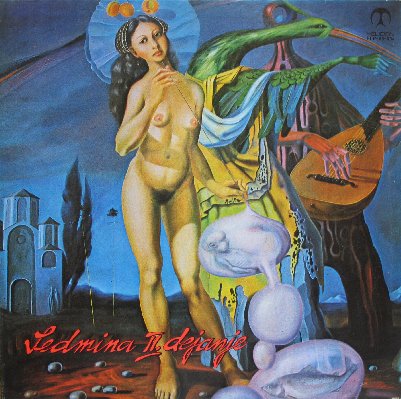
1. Gledališče (4:04)
2. V Polju gre pšenica v klas (4:17)
3. Ciganka (5:59)
4. Circus (9:23)
5. Pav (5:44)
6. Fotograf (5:42)
7. Kolo (Za Duško) (9:21)
Veno Dolenc / acoustic guitars 6 and 12-strings, vocals
Melita Dolenc / vocals
Lado Jaksa / clarinet, saxophone
Edi Stefancic / acoustic guitar, tambouritza, harmonica
Bozidar Ogorevc / violin, viola
Feed your Ears, say thegoodone, to jump over the fence.
The second album of SEDMINA was released in 1982. The band featured the same line-up like on the debut. However, the arrangements are somewhat different, offering longer tracks and more psychedelic, acid-folk sound. Unlike the debut, this one does not attract a listener on the first attempt, but several listens are needed to grasp the feeling. The performance is done with mastery and confidence. The leading instruments are clarinet, violin (and viola, probably because I cannot quite tell the difference) and saxophone, with backing acoustic guitars. Melody lines invoke the medieval or baroque ballads of typical European and Mediterranean musical legacy, but occasional hints of even American folk tunes are also present. "Ciganka" ("Gypsy Woman") is very dylanesque lively folky tune with violin. The epic "Circus" brings an extended violin solo with some eerie, melancholic passages turning more optimistic at the end of the song, with Veno's vocals and saxophone. "Pav" shows the incredible abilities of Lado Jaksa playing outstanding clarinet solo party. Closing "Kolo" brings a drunken, quite morbid and strange tonality, sounding like they had been tuning their instruments along the way - very trippy and mind-bending. The second half of the song is more optimistic because the rhythm is stronger and violin is accompanied very nice solo on acoustic guitar. "II dejanje" is a very dark album. It is also not very accessible and requires attention and patience. At times, it contains rather noisy and cacophonic moments which may force you to stop playing. It is demanding. But we are talking here about "progressive" and "experimental" music, aren't we? This album deserves a lot of guts from listeners. And from reviewers it also deserves something - a recommendation. It is simply not an average folksy troubadour "cry baby". 4,5 stars!
Thanks to progarchives.com. and Seyo
January 3, 2012
Sempervivum tectorum, Ušesnik, Čuvarkuća, Common Houseleek
 Houseleeks or Liveforever, Sempervivum tectorum, Jupiter's eye, Thor's beard, St. George's Beard, and Welcome-home-husband-
though-never-so-
drunk, gromovna trava, pazikuća,
čuvarkuća(Cro), ušesnik, netresk (Slo), was a gift from Jupiter to protect us from thunder and witchcraft, hence it was grown on the roofs of houses. If you give it a search in your language you will probably find that all traditions agree with it's power to protect us from all kinds of evil, maybe some traditions didn't come up with all the ways of exploiting this house doctor, but most of them agree on using it in treating skin and eye diseases, inflammations, burns and ear pain. The names in Croatian like "pazikuča" meaning house
protector or in Slovenian "ušesnik" coming from "ušesa" meaning ears, indicate their use in traditional medicine.
We in the family have very good experience using it to remove warts, treating a cough or sore throat, or ear pain.

In any case of last one, otitis, only pure juice is used, and the leafs must be thoroughly cleaned, not to cause more infection by adding dirt and bacteria into your ear. Just a few drops were enough to ease or completely remove pain from our screaming three year old in the middle of the night. He almost instantly fell asleep and didn't complain that his ears hurt again. Must add that second time it happened due to tonsillitis we got antibiotics, but in two other times we used it it worked like a charm. Some doctors don't approve of this, some do, in case you use this method you really must be careful not to infect the ear even more with pieces of dirt, or pieces of plant, use only juice. Some say that it is good only in the early stage. You must be patient in squeezing it, you can even use a garlic squeezer, and than filter it. It is your responsibility, intuitivly you will know if it is right for you or not, trust that pulse.
Other ways to use it is by putting freshly squeezed juice or crushed leaves as a compress for insect bites (wasps, bees, mosquitoes), burns, chapped and cracked skin, herpes zoster, hemorrhoids. Juice eliminates problems if placed in positions of cramps in legs or sore spot caused by the gout.
When reduced hearing, caused by cured fluid, the fresh juice of leaves is used to

dissolve it. Corns, warts and sun spots are also prevented by fresh juice. Contemporary studies are focused on polysaccharides from the juice, because they are attributed to effects on the immune system and help the cancer disease.
Belarusian experts recommend fresh juice with honey for heart defects, and the products and homeopathic preparations used in purulent inflammation of the gums and sore throats.
Tea made from fresh leaves is applied externally for cladding as well as juice, as a drink for the hemorrhoids, worms, too heavy menstruation, stones in the bladder. It refreshes the body, has a diuretic effect and reduces inflammation. (translation from)
Belarusian experts recommend fresh juice with honey for heart defects, and the products and homeopathic preparations used in purulent inflammation of the gums and sore throats.
Tea made from fresh leaves is applied externally for cladding as well as juice, as a drink for the hemorrhoids, worms, too heavy menstruation, stones in the bladder. It refreshes the body, has a diuretic effect and reduces inflammation. (translation from)
Other common names, such as Anglo-Saxon singrēne, Modern English sigrim, sil-green, etc. and aye-green,refer to its longevity. William Fernie tells a tale in support of this:
History relates that a botanist tried hard for eighteen months to dry a plant of the House Leek for his herbarium, but failed in this object. He afterwards restored it to its first site when it grew again as if nothing had interfered with its ordinary life. (Wiki)
One more source in Slovenian: http://www2.arnes.si/~sopjslat/netreski/uvod.htm, with names in several languages, thank you very much.
Also take a peek at: http://sempervivum.aforumfree.com/
Thanks to Renata

December 30, 2011
Ethiopian Soul and Groove

...& a little present for your new year's eve
the Wallias Band,Alèmayèhu Eshèté,Gétatchèw Mèkurya,Mahmoud Ahmed & co
during their heyday and
doing it to death....
a1-Wallias Band-Muziqawi Silt
a2-Alèmayèhu Eshèté And Hirut Bèqèlé-Tèmèlès
a3-Samuel Bèlay-Aynotchesh Yerèfu
a4-Ayalèw Mèsfin-Hasabé
a5-Seyoum Gèbrèyès & Wallias Band-Muziqa Muziqa
b1-Gétatchèw Mèkurya-Yègènèt Muziqa
b2-Mahmoud Ahmed-Kulun Mankwalèsh
b3-Tamrat Fèrèndji -Antchin Yagègnulet
b4-Assèlèfètch Ashinè & Géténèsh Kebrèt-Amlak Abét Abét
my rip of

December 27, 2011
Balžalorsky Drašler 3o - Wu-wei

Vitja Balžalorsky - guitar, electronics
Jošt Drašler - bass
Vid Drašler - drums and other sounds
Young, Slovenian jazz trio with mature sound, left me surprised, even more when I noticed their age. I put the Cd in the stereo and some warm, pleasant tones filled the room, even my three and a half year old gave me an approving look nodding his head and lifting his eyebrows. There is an review on http://zalozba.radiostudent.si, please use translator,my English is too bad to translate it myself and I am also a lazy ass. Some comparison has been made with the ECM material, the peacefulness of John Abercrombie's jazz also has been mentioned, and some praises of Jošt Drašler's firm base, I agree with all of those claims, all is in favour of those three great musicians, that I hope that they look at a wonderful future.
Wu-wei by Balzalorsky/Drasler 3o

December 25, 2011
Group Doueh-beatte harab


As a youth, Baamar listened to cassettes of James Brown and Jimi Hendrix imported from Spain. His first experiences as a professional musician were playing at local parties coincided with Mauritania’s occupation of Dakhla. You can hear both Western rock influence and Mauritanian rhythms in his music, which he’s been performing and marketing on cassette for over a quarter century throughout the Western Sahara region. Doueh plays electric guitar and the tinidit (or tidinit),the Moorish four-stringed lute.

I liked beatte harab from the beginning
even more than their 2 first records as this is a more straight forward traditional recording .
today I checked my files and found an impressive number of dls
without posting it anywhere..
just happy that people began appreciating them for their music
at last and not for any (stupid) hype---so here it is in the light of day.
December 14, 2011
Tamara Obrovac & Transhistria ensemble - Sve pasiva (All fades away)

2 Sve pasiva / All fades away (5:01)
3 Ne plači Lucija / Don't cry Lucija (5:55)
4 Ča mi povida more / What sea tels me (5:58)
5 Cansoneita / Chanson (6:00)
6 Sexuvalna (5:42)
7 Duet / Duo (3:30)
8 Stila / quiet (3:30)
9 Sudba ti je došla / Your faith has come (4:21)
10 Divojka / A girl (4:44)
11 Ona je čekala / She has waited (6:10)
12 Črno zlo / Black evil (4:57)
13 Sexuvalna live - bonus track (4:53)
Life is short, don't waste time
a tune, write a rhyme
all will pass, even sound
what's to do, you demand
listen, laugh, have fun
and be thegoodone
The composer singer and flutist Tamara Obrovac, is one of the most impressive artists on the Croatian music scene, she is one of those musicians to whom jazz means a path to understanding music as a whole. Moreover, it has ushered her towards an intensive investigation of her own regional music awareness, so she offers us a new musical journey through the Istrian and Mediterranean spaces and times. Istria is here homeland, beautiful Croatian region, a North Adriatic peninsula, particular for It's musical and dialectal tradition, which is the creative force of her works. She writes lyrics in a local dialect and sings in an ancient dialect which is not spoken any more - the Istriotic dialect.
Her international Transhistria Ensemble incorporates elements of Istrian and Mediterranean national music, jazz, and many elements of modern music, and her music, completely original and autochthonous, goes beyond time and geographical boundaries, thus becoming a universal artistic message, establishing Tamara Obrovac as an exceptional artist who managed to create her own unique musical expression. This creative musician has become known for her highly aesthetic performances, her interpretations are suffused with spontaneity, inventive improvisation, freedom, humour and the ability to communicate with the audience, an artist of a strong persona, a life and artistic force able to enchant any audience...
As she said: “jazz is my freedom, and my roots are my inner truth...”
source
Personal note,
For me this is the best thing I heard In Croatian Discography. A balsam for a Mediterranean soul.
December 7, 2011
Kiko Dinucci, Juçara Marçal & Thiago França -Metá Metá
a little shout out for a very recent record that managed to become (almost) an instant classic! in 2011? well,this is what I call a big achievement-the comparisons with Baden Powell's /Vinicius de MoraesAfro-Sambas were inevitable(and the original Afro-Sambas are always here to judge for yourself)
enjoy Metá Metá and join (as I did) their club of fans-for their originality ...

The first album by Metá-Metá achieves two remarkable things; it manages to sound unbelievably fresh as well as sounding as if it could have come from Brazilian music’s hey-day of the 1960s.
Metá-Metá is essentially three musicians, Juçara Marçal on lead vocals, Kiko Dinucci on guitar and backing vocals, and Thiago França on sax and flute. Throughout this debut album I had the feeling I was listening to a long-lost Afro-Sambas tape, which I mean as the greatest tribute. This is guitar work as accomplished as Baden Powell, vocals from Marçal that are equal to greats such as the Maria Bethania and Maria Creuza. And while it will take me a while to decipher whether the lyrics are as strong as those of Vinicius de Moraes, this overall is an album that has that same environment that bestowed those ground-breaking Afro-Samba albums of the 60s.

Kiko Dinucci has been improving as a samba guitarist over the years, as well as becoming more and more embroiled in the world of candomblé, an Afro-Brazilian religion with a strong dance and musical element. In Juçara Marçal he has partnered with a singer who is just as passionate as the religion. The added atmospherics applied by Thiago França add another dimension to this music but it is the voice of Marçal and Dinucci’s dextrous, direct guitar-playing which steal the show.
The opening track “Vale do Jucá” and “Vias de Fato” are the two tracks that most readily resemble the works of Vinicius de Moraes and Baden Powell on the original Afro-Sambas, both strong samba songs with the eerie atmosphere that seemed to imbue many of those original songs. As a contrast “Umbigada” is a sunny melody that sings straght to the heart with a great telepathy between the guitar and flute that intertwine on the way to making the gorgeous melody.
Interestingly the repeated refrain and whispered vocals of “Papel Sulfite” bring to mind Juana Molina, an artist coming from a very different background. Other songs that push Metá-Metá in new directions are “Oranian”, a full band effort which occasionally erupts into a cacophony of drums and sax with Marçal’s singing almost rap-like in it’s directness and flow; and “Obá Iná” which starts with a guitar line which could easily have come from one of the punk bands that Dinucci was in in his early days. This track and the following “Obatalá” are two where there seems to be more of a jazz connection with cymbals crashing, França playing a bigger role on sax and there generally being a sense of free-form construction.

Metá-Metá is truly an extraordinary record, one with a strong candomblé heart – the gods Oxum, Xangô and Obatala feature heavily on these songs – but that also works as a great samba and jazz record. Kiko Dinucci and Juçara Marçal originally worked together on the 2009 album Padê, which was under their two names. That record had it’s moments, but it’s here as Metá-Metá with the presence of Thiago França that they have really managed to find their feet and produce something timeless which will surely be revered for some time, as well as vying with Criolo for the best album of 2011.
review from sounds and colours
You can download Metá-Metá for free from
Kiko Dinucci’s website
Subscribe to:
Posts (Atom)