Showing posts with label Brasil. Show all posts

May 9, 2013

Nelson Sargento ~ sonho de un Sambista


...as a  piano is  not just a piano
and  water is H2O and  hundreds of rivers  and seas    
Samba is bigger than life and  thousands  of  life's stories..

an exquisite and much loved artist  -Nelson Sargento : 


Nelson Sargento is the artistic name of Nelson Mattos, born on the 25th of July, in a public hospital (Santa Casa de Misericórdia) in Rio de Janeiro. He was raised in Tijuca, in the house of Portuguese shop owners for whom his mother worked as a housemaid. On weekends his mother would take him to visit their family  on the morro (hill) of Salgueiro, a redoubt of samba, and when he was twelve they moved to the morro de Mangueira.
Nelson is the last of the old guardia of Mangueira, Rio's most storied samba school. His "As Quatro Estações do Ano" is considered to be Mangueira's most beautiful carnival samba of all time.......

Em Português


um sonho

March 27, 2012

Sambanzo~Etiópia


music has always been free,like the birds,the water we drink, the sun
and in reality there is no way to cage  music if you don't want to  kill it.
have you heard of anyone able to  imprison love,passion,despair or joy ?
very few seem to remember or even understand this simple truth but more are starting to realize it
and mostly the artists as  they become  aware  that in   liberating  their art  they liberate their own potentials.
Saxophonist Thiago França comes after   Metá-Metá , with  a constellation of  musicians like  Kiko Dinucci, Marcelo Cabral,  Samba Ossalê  and Wellington "Pimpa" Moreira under the collective name of  Sambanzo ( Samba & the Yoruba Banzo which has a meaning similar to the blues or the longing for the Motherland that the slaves felt) that  lovingly prepared a powerful afrobeat ,samba and  jazz conversation with  the Afro-Brazilian roots and they are offering  it to anyone wishing to dig into this new global African sound that is unfolding  as a celebration  from  São Paulo  to  Addis Ababa and to all corners .
thank you  Thiago França  and Sambanzo.  Música livre, sempre! 

December 7, 2011

Kiko Dinucci, Juçara Marçal & Thiago França -Metá Metá


a little shout out for a very recent record that managed to become (almost) an instant  classic! in 2011? well,this is what I  call a big achievement-the comparisons with Baden Powell's /Vinicius de MoraesAfro-Sambas were inevitable(and  the original Afro-Sambas are always here to judge for yourself)
enjoy Metá Metá  and  join (as I did) their club of fans-for their originality ...


The first album by Metá-Metá achieves two remarkable things; it manages to sound unbelievably fresh as well as sounding as if it could have come from Brazilian music’s hey-day of the 1960s.
Metá-Metá is essentially three musicians, Juçara Marçal on lead vocals, Kiko Dinucci on guitar and backing vocals, and Thiago França on sax and flute. Throughout this debut album I had the feeling I was listening to a long-lost Afro-Sambas tape, which I mean as the greatest tribute. This is guitar work as accomplished as Baden Powell, vocals from Marçal that are equal to greats such as the Maria Bethania and Maria Creuza. And while it will take me a while to decipher whether the lyrics are as strong as those of Vinicius de Moraes, this overall is an album that has that same environment that bestowed those ground-breaking Afro-Samba albums of the 60s.


Kiko Dinucci has been improving as a samba guitarist over the years, as well as becoming more and more embroiled in the world of candomblé, an Afro-Brazilian religion with a strong dance and musical element. In Juçara Marçal he has partnered with a singer who is just as passionate as the religion. The added atmospherics applied by Thiago França add another dimension to this music but it is the voice of Marçal and Dinucci’s dextrous, direct guitar-playing which steal the show.
The opening track “Vale do Jucá” and “Vias de Fato” are the two tracks that most readily resemble the works of Vinicius de Moraes and Baden Powell on the original Afro-Sambas, both strong samba songs with the eerie atmosphere that seemed to imbue many of those original songs. As a contrast “Umbigada” is a sunny melody that sings straght to the heart with a great telepathy between the guitar and flute that intertwine on the way to making the gorgeous melody.


Interestingly the repeated refrain and whispered vocals of “Papel Sulfite” bring to mind Juana Molina, an artist coming from a very different background. Other songs that push Metá-Metá in new directions are “Oranian”, a full band effort which occasionally erupts into a cacophony of drums and sax with Marçal’s singing almost rap-like in it’s directness and flow; and “Obá Iná” which starts with a guitar line which could easily have come from one of the punk bands that Dinucci was in in his early days. This track and the following “Obatalá” are two where there seems to be more of a jazz connection with cymbals crashing, França playing a bigger role on sax and there generally being a sense of free-form construction.


Metá-Metá is truly an extraordinary record, one with a strong candomblé heart – the gods Oxum, Xangô and Obatala feature heavily on these songs – but that also works as a great samba and jazz record. Kiko Dinucci and Juçara Marçal originally worked together on the 2009 album Padê, which was under their two names. That record had it’s moments, but it’s here as Metá-Metá with the presence of Thiago França that they have really managed to find their feet and produce something timeless which will surely be revered for some time, as well as vying with Criolo for the best album of 2011.

review from sounds and colours 

You can download Metá-Metá for free from  
Kiko Dinucci’s website


July 11, 2011

Yanomami

‘We learn with the great spirits’ 


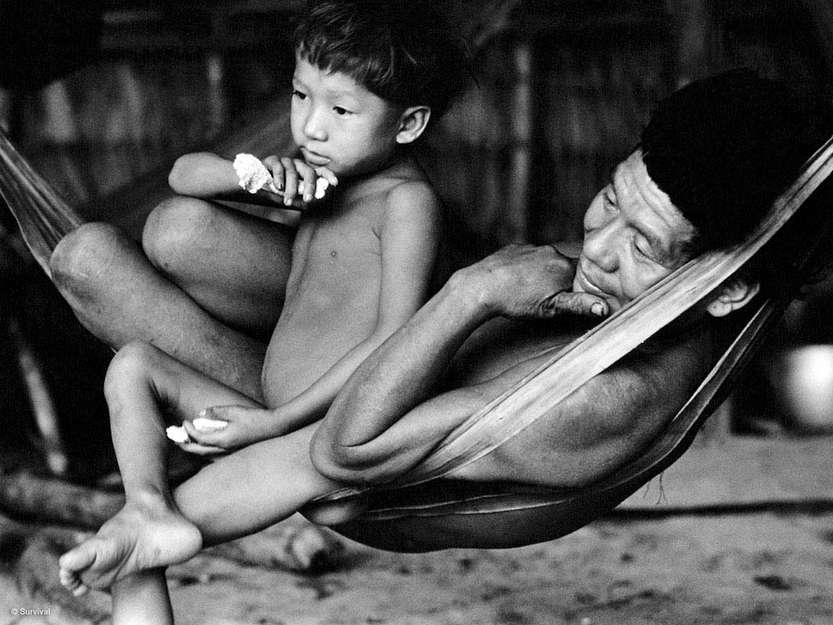
Picture © Claudia Andujar/Survival

The word, ‘shaman’, is thought to have originated with the Evenk people of Siberia, but shamans have a pivotal role in many tribal societies. Typically, they are men and women who specialise in communicating with the natural world and its spirits; people who have a heightened awareness of the divine and the intangible.
Shamans have many roles. They are variously healers and priests, custodians of their peoples’ sacred rituals, weather diviners, cosmologists, dream tellers and keepers of botanical knowledge.
Guided by spirits (xapiripë) and the wisdom of their ancestors,Yanomami shamans (xapiripë thëpë) command thunder storms and caution the winds.They prevent the sky from falling down and use their powers to ensure hunting successes, cure human diseases and put flight to hostile spirits.
The shamans give orders to the sun, and instruct the spirits to speak to the moon.


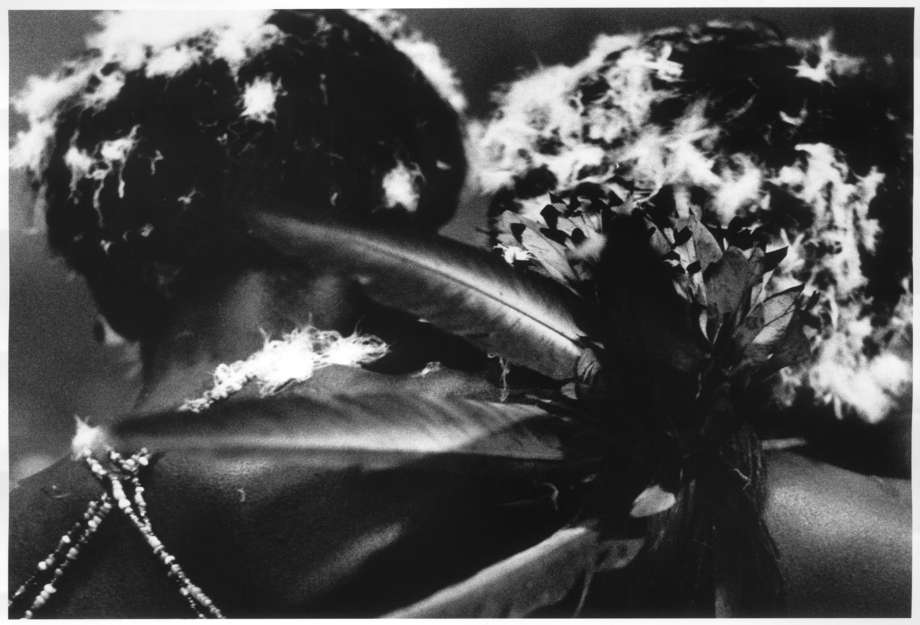
Picture © Claudia Andujar/Survival

I am shaman of the rainforest and I work with the forces of nature, not with the forces of money or weapons, says Davi.
Our wisdom is different. Our knowledge is a different knowledge.
It is the wisdom of our shamanic spirits, of the Earth, which is very important for the survival of humanity.


Picture © Claudia Andujar/Survival


Through dreams and trances, Yanomami shamans transcend the physical confines of their bodies and the limits of the human consciousness to commune with the xapiripë.
We Yanomami learn with the great spirits, the xapiripë. We learn to know the xapiripë, how to see them and listen to them. Only shamans – those who know the xapiripë – can see them, because they look like humans but are tiny as specks of sparkling dust and bright like light.
Their songs are powerful, and their thinking is straight.


June 18, 2011

Baden Powell & Vinicius de Moraes - Afro-Sambas


In the early sixties Vinicius de Moraes was given by Carlos Coqueijo Costa a copy of the LP sambas de Roda e Candomblés da Bahia  a record that deeply impressed the poet, revealing to him an aspect of popular music that he had not yet discovered. Vinicius then showed the record to his friend and partner Baden Powell who was  also dazzled. In 1962 Baden visited  Bahia to present a show with Silvia Teles at the Country Club,and got  acquainted with some artists and intellectuals from Bahia and as he demonstrated his interest in Bahia's African traditions he was  presented to capoeirista mestre Canjiquinha. with Canjiquinha Baden visited the terreiros and the  rodas de capoeira   where the most  important performances of  the songs and the sounds of Candomblé where given. Baden was fascinated, not so much by the mystical sense of what he had seen, but with the beauty of the harmonies he had heard.
When Baden was   reunited with Vinicius  started composing berimbau sambas  and resolves to start composing a series of songs about African culture in Brazil.Around that   time Baden Powell was studying Gregorian chants with the conductor Moacyr Santos and realized there were some resemblances to the afro songs he had heard  in the terreiros of  Bahia and inspired by these two influences he came with   a series of themes composed by merging them with the beat of samba. the result is splendid and of great melodic beauty, giving rise to a new kind of music, the african sambas in the words and the lyrics of Vinicius de Moraes that would be the hallmark of the musical work of Baden Powell

 Luiz Américo Lisboa Junio

Afro Sambas


probably you know it already since a long time,most likely you have it too in one form or another-it's everywhere too thanks to all good fellow bloggers,definitely one of the,or THE, modern samba  milestone-s, and as  I feel like revisiting   familiar and loved sounds I share this age long affair here too and  I propose a fresh listening for today , take it or leave it.


Vocais: Vinicius de Moraes, Quarteto em Cy e Coro Misto
Sax tenor: Pedro Luiz de Assis
Sax barítono: Aurino Ferreira
Flauta: Nicolino Cópia
Violão: Baden Powell
Contrabaixo: Jorge Marinho
Bateria: Reisinho
Atabaque: Alfredo Bessa
Atabaque pequeno: Nelson Luiz
Bongô: Alexandre Silva Martins
Pandeiro: Gilson de Freitas
Agogô: Mineirinho
Afoxé: Adyr Jose Raimundo


.

March 18, 2011

for all or for maids and taxi drivers only ?


There are three or four competing theories about the origin of the word forró. The most convincing is that forró is a derivative of forrobodó, an Afro-Brazilian word meaning “great party” or “commotion.” Another theory holds that forró is a corruption of “for all” and dates from the early 1900s, when the railroad companies would throw big dances on the weekend and designate them as either “employees only” or open to the general populace, “for all.”
Forró emerged as a distinct style of dance music in the late 1800s, about the time Brazil was in the process of becoming a republic. Forró, a name which refers both to a dance and to the accompanying music, is an energetic blend of Afro-Brazilian percussion and European dance music of the late 
1800s, specifically the polkas, waltzes and mazurkas that constituted the primary accordion repertoire at the time.
Forró developed in the northeastern part of Brazil, the most Africanized region of the country. Most of the African slaves the Portuguese brought into Brazil worked the huge plantations along the Atlantic coast, and many of the descendants of those slaves have remained in the general area. Relegated to less desirable land a few miles inland, large numbers of thenordestinos (northeasterners) live in an arid, rocky region known as the sertão.
Life there is hardscrabble and unforgiving. Forró began the evolution from regional style to national obsession as nordestinos gave up on farming and moved to an even more uncertain life in the coastal cities such as Recife and Salvador and, farther south, Rio de Janeiro and São Paulo. The harshness of life on the sertão is indicated by the name given to those who pack it in for the cities—flagelados, the scourged.
The nationalization of forró was completed by accordionist Luiz Gonzaga (1912-1989),
who reinvigorated the traditional folk style and turned forró into a national craze
that has influenced all subsequent Brazilian music.
 Traditional forró, known as forró pé de serra, is played on just three instruments: the piano accordion, a metal triangle and a large bass drum called the zabumba, played with a mallet in one hand and a stick called a bacalhau in the other. The melody is played by the accordion, with the drum and triangle pounding out a surprisingly complex and funky polyrhythmic beat.
Forró includes both accordion-led instrumentals and songs. Like vernacular music the world over, the subject matter of many forró songs is love, in all of its many manifestations—lost, found, unrequited, unforgettable, passion, jealousy and so on. Songs that aren’t about love mainly address the more serious concerns of the nordestinos—alienation, cultural dislocation, racial prejudice and a longing sense of nostalgia. 


01-Toinho De Alagoas - Balanço da Canoa
02-Duda Da Passira-De Pernambuco ao Maranhão
03-José Orlando-Eu Também Quero Beijar
04-Tionho de Alagoas-Bicho da Cara Preta
05-Heleono Dos Oito Baizos-Comeco de Varão
06-Tionho de Alagoas-Peca Licenca P'ra Falar de Alagoas
07-Duda Da Passira- Recordação Da Passira
08-Jose Orlando-Agricultor P'ra Frente
09-Heleono Dos Oito Baizos-Entra E Sai
10-José Orlando-Linda Menina
11-Duda Da Passira-Casa de Tauba
12-José Orlando- Morena da Palmeira
13-Tionho de Alagoas-Caráter Duro
14-José Orlando- Minha Zezé
15-Tionho de Alagoas-Sonho de Amor
16-Tionho de Alagoas- Namoro No Ascuro
17-Duda Da Passira-Forró da Minha Terra


December 21, 2010

Brazilian spices...

Tania Maria
Piquant

Picante/Concord, 1980

Tracks:

1 - Yatra-Tá - Tania Maria/Correa Reis
2 - It's not for me to Say - Robert Allen
3 - Triste - Jobim
4 - Chiclete com Banana - Jackson Do Pandeiro.
5 - Lemon Cuica - Tania Maria/Correa Reis
6 - Super Happy - Tania Maria
7 - Començar de Novo - Ivan Lins/Victor Martins
8 - Vem P'ra Roda - Tania Maria/Correa Reis

Personnel:

Tania Maria: Piano, Vocals
Willie T. Colon: Percussion
Eddie Duran: Guitar
Rob Fisher: Bass
Vince Lateano: Percussion, Drums

Phil Edwards: Engineer
Cal Tjader: Producer

Great stuff! Tania Maria's first few years recording in the US were some of her best – and this excellent groover on Picante features some very tight Brazilian jazz tracks, cut with a small combo of west coasters, and produced by Cal Tjader with a smooth jazzy vibe. The overall sound is nicely stripped-down, and the main focus is on Tania's soulful voice and piano. Titles include "Lemon Cuica", "Chiclete Com Banana", "Yatra Ta", "Comecar De Novo", and "Super Happy".  © 1996-2010, Dusty Groove America, Inc.

-:-

Tania Maria's debut American release helped introduce her to U.S. audiences. Joined by a quintet that includes guitarist Eddie Duran, the exuberant vocalist and pianist performs four of her colorful originals, a couple of obscurities, and a song apiece by Jobim ("Triste") and Ivan Lins. Maria's mixture of Latin jazz with Brazilian pop is quite appealing and helped make her a popular star; this was one of her better efforts.
~ Scott Yanow

Dear Scotty:
Jackson Do Pandeiro: "a couple of obscurities" ... where do you live? in a cave?!

***

Jazz, Pop, Latin, who cares  :)

if it's tasty we call it music :)

some more ?