Showing posts with label Ney. Show all posts

March 13, 2013

Ottoman

Kanun: Turgut Özüfler
Keman: Hasan Nar
Ney: Başar Dikici
Tanbur: Alper Uzkur
The Ottoman Classical Palace Music

Tracks:

01.Acem Aşiran Saz Semaisi (Mısırlı İbrahim Efendi)
02.Hüseyni Peşrev (Lavtacı Andon)
03.Hüseyni Taksim (Ney Tanbur)
04.Hüseyni Saz Semaisi (Lavtacı Andon)
05.Segah Peşrevi (Yusuf Paşa)
06.Ferah Feza Taksim (Tanbur)
07.Ferah Feza Saz Semaisi (Tanburi Cemil Bey)
08.Hicaz Saz Semaisi (Refik Talat Bey)
09.Hüzzam Taksim (Kanun - Keman)
10.Neveser Taksim (Tanbur)
11.Kürdili Hicazkar Taksim (Tanbur)
12.Muhayyer Saz Semaisi (Tanburi Cemil Bey)

OTTOMAN MUSIC AND ITS INSTRUMENTS


Music occupied a very important place in Ottoman society. Topkapi Palace was a virtual conservatory, where both women and men received intensive training in music. Every concubine mastered an instrument while also being instructed in singing and dancing. Indeed, there were concubines who learned to play the trumpet, usually considered a man’s instrument. The men, on the other hand, received their musical training in the Enderun, which was the palace school. Albertus Bobovius, for example, a Pole who entered this school while still young and spent twenty years there, contributed a great deal to Turkish music. Bobovius, who in Turkey took the name Ali Ufkî Bey and was an interpreter and translator at court, transcribed 544 works of Turkish music into European notation. It is thanks to this effort that these pieces can be played today.
In order to grasp the importance which music had for the Ottomans, and the place it occupied in their culture, one must understand its three functions: Concert music, music for accompaniment, and visual impact.

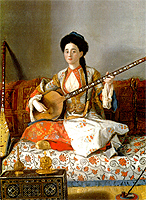
Concert music, whether at the palace or elsewhere, was simply to be listened to. Among the Ottomans, concerts were performed both indoors and outdoors. A picture the original of which is in the Warsaw University Library depicts twelve Ottoman musicians giving a concert at the British Embassy on February 22, 1779. The instruments employed were three neys, a violin, a ‘kemânçe’, a ‘santur’ (the Turkish dulcimer), three tambourines, one ‘miskal’ (a multi-reeded wind instrument), and two ‘tanburs’. We have many miniatures and paintings which show female instrumentalists and concerts given among women. One such work is an 18th-century miniature now in the Philadelphia Free Library. In it, four female musicians perform for a lady in the garden of a palace or mansion, while a servant serves the lady a drink. The instruments depicted in the miniature are the tambourine, kemânçe, tanbur and ‘kanun’.

Music for accompaniment, on the other hand, was highly important for the art dances performed sometimes by women and sometimes by men dressed as women. Here music and dance were so closely intertwined that we might call such performances “visual concerts.” Music functioned as accompaniment in other types of show as well. One can cite the performances of tumblers, acrobats, jugglers, magicians, jesters and wrestlers, as well as those by trained animals. A miniature depicting festivities held in 1582 has two acrobats, two dancers and four jesters accompanied by the music of a tambourine, miskal, çagane and kopuz.

Visual impact was the third major element in Ottoman music. The costumes of the instrumentalists, and the unusual or majestic aspect of some musicians, appealed to the eye as much as to the ear. The sultan’s processions included other performances besides music. In the middle of a miniature depicting a procession of Sultan Murad III we see this ruler on horseback, while in the lower part of the work there are two dancers and a jester accompanied by a stringed instrument, and in the rear a mounted ‘mehter’ band.
Music and dance also figured prominently in the processions of tradesmen, which lasted for hours. Ottoman ambassadors who had been posted to some country, say Vienna or Paris, would enter the city with a large procession which included a sizeable mehter band on horseback. So magnificent were the scenes that the public and the courtiers watching were deeply stirred. And the ranks of those who were moved also included composers. The tradesmen’s processions inspired such greats as Mozart, Haydn and Beethoven, in whose works this Ottoman music was reflected.

The fact that music appeared in the festivities simultaneously with other types of performance did cause one problem: when different kinds of music were played at the same time, they struck the ear all together, and there was no way to make a choice. There are numerous examples of this. Consider, for instance, the miniature which shows festivities held in 1582. A ‘köçek’, that is a male dancer dressed as a woman, does his stuff for thousands of spectators to the tune of his own music. Elsewhere a Mevlevi whirls in a religiously motivated dance called the ‘sema’, again accompanied by his own music. The public can watch the köçek’s dance and the sema separately, but how are they going to keep the two different kinds of music apart. The answer is very simple: Even if the clashing types of music turned into noise, the spectators, caught up in the exuberance of the festivity, just didn’t care. On the other hand, foreigners who witnessed the festivities and wrote about them in books and reports say the cacophony of hundreds of clashing instruments, and all those songs, did indeed disturb them. The reason was that they, as strangers, were unable to surrender themselves to the festive atmosphere.

There was a wealth of instruments in Ottoman days. In his book of travels, Evliya Çelebi describes a parade of all the guilds past Sultan Murad IV, giving a full list of instrumentalists, instrument makers and singers, and points out that there were some “hundred” names for instruments. Every instrument had its own name, even when they belonged to the same family. Some of the better-known stringed instruments were the kopuz, çeng, kemânçe, violin and lute, while the winds included the horn, ney, miskal and zurna. Prominent percussion instruments were the triangle, drum and ‘çagane’. Most of the Ottoman instruments have unfortunately not come down to our age, being lost in the mists of time. One reason is that during the 19th century growing Westernization led to the use of European instruments. Indeed, such once-popular instruments as the çeng and miskal have vanished completely, not a single example being left even in the museums. But luckily we have drawings in miniatures and old books on music.

Reference: Prof. Dr. Metin And / SKYLIFE

source 

çeng and miskal ; )
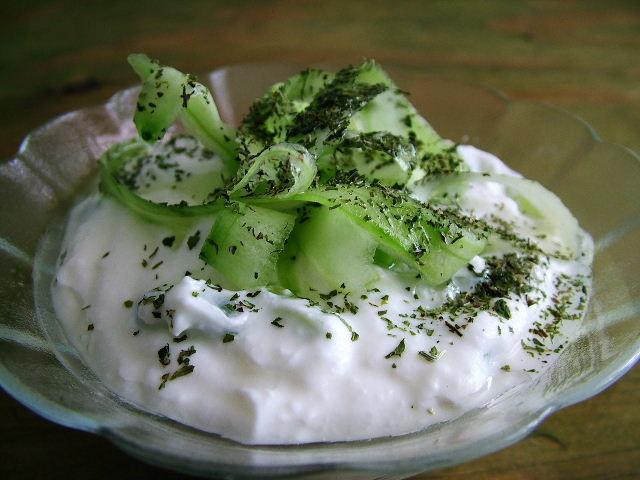


YOGURT


A dish that is to be accompanied by yogurt is a must on any traditional Turkish table - unless of course, there is already another dish whose main ingredient is yogurt. For thousands of years, yogurt has been an indispensable element on Turkish tables. It is consumed plain or as a side dish, and it is a crucial part of Turkish Cuisine. Yogurt is used to make soups, sweets, and the favorite drink ayran, which is made by mixing in water, mineral water and salt. Another reason why Turks hold yogurt dearly is that all over the world it is consumed and known as “yogurt,” which is a word of Turkish origin.

About a thousand years ago, Turks were the first to make Yogurt. The oldest known lexicon of the Turkish language, Kasgarli Mahmut’s Divân-i Lûgat’i Türk has an entry for the same word, and it has the same meaning. At the time, Turks still led nomadic lives and had devised numerous methods to preserve their food for their long journeys. This is one of the reasons why milk was made into yogurt. The best quality yogurt is produced through the fermentation of cow and lamb’s milk. It is not surprising that dairy products made from these animals are Turkish inventions; Central Asian Turks were the first to domesticate lambs and cows. As it was first spreading into Europe and elsewhere, this thick, white dairy product was used for therapeutic purposes; in the 20th century, its daily use spreads all around the world.

The transformation of milk into yogurt is the feat of lactic acid-yielding microorganisms. Yogurt is basically coagulated milk produced by the partial transformation of milk lactose into lactic acid through the effect of yogurt yeast. The initial production step is to boil the milk. The boiled milk is left to cool until it won’t burn your finger and then two teaspoons of starter yogurt added gently from the edge of the container. The container is then sealed and usually placed in a nest of towels to keep the milk warm and the fermentation going. Fermentation takes 4 to 5 hours at a temperature of approximately 37 degrees.

Yogurt can be classified under three groups depending on the production method; in addition to the regular yogurt whose production has been outlined above, there is also the Silivri Yogurt and strained yogurt. Silivri style yogurt is proper to the Istanbul region, and it is produced with lamb’s milk only. This is a tasty, firm and very creamy variety of yogurt. The procedure involves first boiling the milk in large cauldrons. Then the milk is poured into containers in a way to develop froth. Blazing coals are placed under these containers, and the yogurt is left to sit. Consequently, a harder and slightly cooked creamy top is obtained. When the containers are cool enough, glass syringes are used to inject yogurt yeast to the mixture from all four corners. Following this procedure, the containers are sealed with large wooden covers. After settling for 4 to 5 hours, the Silivri yogurt is then ready for consumption. The same initial procedures are followed to produce strained yogurt, however the creamy top is later removed and the remaining yogurt is placed in finely woven cloth bags. The bags are then hung at a height to allow the liquid to strain off. Finally, the strained yogurt is transferred to tin containers. Strained yogurt contains no vitamin B, since this ingredient is moved out along with the liquid as it is strained off.

It would be almost impossible to find a Turkish household that does not have yogurt in the refrigerator. Turks, who use yogurt widely, believe that it is a health food, with ability to cleanse the body from toxins and poisons. Even dreaming of yogurt is considered a good omen as a sign of upcoming wealth and a long life.
 
Reference: Yesim Gokce (Bilkent University)/Turkish Cultural Foundation

source

November 8, 2011

Turning Dervishes Of Konya - Odes De Ney: The Cosmic Dances Of The Turning Dervishes


The Turning Dervishes from Konya
- The Mevlevi Round Dance

Nobody knows the origin of this unique rite, probably it derives from a constellation cult, practised long before the dervishes adopted it and gave it a new meaning.
The position of the head and hands is typical. The right, "good" hand is opened and held towards the sky, the left, "improper" hand is held towards the earth. The head is slightly inclined to the right shoulder. The eyes are varly closed and are focussing the left thumb. A general belief is, that the dervishes have magic forces during their dance.
Once a year these Turning Dervishes, the Mevlevis, are meeting in Konya, in the highlands of Anatolia, and perform their dance in the hall of sports. Only one hour they are dancing, remembering to big white butterflies. Officially there are no mystic brotherhoods in Turkey since 1920's, and these dervishes need a special allowance from the Turkish government for their festivity to honour the founder of this sect, Mevlana Dschelal ed-Din Rumi (Jalāl ad-Dīn Muḥammad Rūmī), each December.
At the beginning there is a procession. Then the participants are lining up. The Sheikh, head of tl4e sect, has a special place in front of an altar showing towards Mekka. Holy City - altar - a red-coloured sheepfur, the place of the Sheikh, are on one line,
dividing the dance floor into two equal halfs, a mystic line called equator. The orchestra is playing mostly with "neys" (the Oriental flute of reed) and drums. All dervishes are wearing the conical "sikke", a cap made of felt, being the sign of the Mevlevi Sect, and the black-coloured "hirka" (cowl). The festival starts with a hymn to praise the Prophet Muhammad and a piece for solo flute. Then the dancers are walking three times around the Sheikh and the dance floor and return then to their places. After a second flute piece, accompanied by Per-sian songs and orchestral music the dance itself starts. The dancers are now wearing their white clothes only, the "tennure", and a short waistcoat called "destegiil". The hands crossed over their breast, the dancers are walking to the Sheikh, kiss his hands and are receiving a kiss on their caps. Then they start turning around themselves in left direction.
The origin of the Mevlevi Sect is going back to a public anger which ocurred in the year n44, exactly on November 3oth 1244.
An imam, Dschelal ed-Din, fell in love with a foreign preacher in Konya. Dschelal ed-Din came from the city of Batch (today in Afghanistan) and counted 37 years. He was a professor and mufti and belonged therefore to the important people of Konya. His students called him respectfully "Maulana", in Turkish language "Mevlana"(Mevlâna,Our Guide). Due to this love he became a stranger in his city overnight. He neglected his duties and services, but people did not realize that Mevlana had not seen a normal man in this foreign preacher, but a portray of God.
The Sufi, the Islamic mysticals, were searching for God's presence already on earth, and the unification with God. The mystic beliefs of Mevlana and most Sufis are bearing on the following thoughts: Except God there is no reality. Man itself is without a real being, but may participate - under certain circumstances - in the reality of God. This assumption is fulfilled, when man has freed himself from his own, human qualities. The way to this freedom is suffering (not in a stupid self punishing way of course, in The Sufi path of love: the spiritual teachings of Rumi, in section on separation and union at about pages 236 to 238 you can read Rumi's thoughts on this ". The power to go this way is coming from his love for God.
In February 1146 Dschelal ed-Din and Schems ed-Din, the preacher, were separated by jealous students. Schems ed-Din returned once again to Konya in later years, but he disappeared under unknown circumstances. Konya found its Mevlana again, but he was not the same anymore. Twice again Mevlana fell in love with other men. His last love was Hilsam ed-Din, member of a family with great influence. Due to this love, Mevlana wrote a giant poem called "Mesnevi" (alternate link), influencing Islamic mystics in an incredible way. The first verses of this poem are considered to be influenced by God. This poem is generally known as the "Lament of the Ney". In the second half of his life, Mevlana became the mystic father of Konya. He was called "Sultan of the Lovers". In his last years of life the Sect of Mevlevis was founded, the origin of the Turning Dervishes. The final form was given to the sect by Sultan Veled, the son of the master. In the evening of 17th December tin Mevlana died.
The Sect of Mevlevis treasured his heritage for over 700 years, but with some renewed interpretation. Today the tomb of Mevlana is never without visitors. Those who have the opportunity to observe the Mevlevis for some days will see that there is a very deep believe behind the Turning Dervishes from Konya.
form linear notes with some intervention

Terms of Mevlevi order


1 Naat (Lounge)
2 Peshrey (Prelude)
3 Niyaz Ayin (The Cosmic Dance)
4 Hay (Zirk) (Invocation)
5 Son Peshrev (Postlude)
6 Bayati Semai (Interlude)
7 Nukte (Humour)
8 Ferahfeza
9 Yayli Tanbur (Arch-Lute)
10 Bishnev Ez Ney
11 Odes De Ney (Ode)
12 Tanbur (Long-Neck Lute)

word
thegoodone


May 1, 2011

Mohammad Musavi - Ney of Mohammad Musavi


Firs a small remark acording to some sources it is Mohammad Mousavi, not Musavi, but I am going to leave it as on this edition of CD. All apologies to anyone that might feel piqued, if you are sure what is correct please say.

IRAN : THE NEY OF MOHAMMAD MUSAVI
Mohammad Musavi was born in 1947 in Ahvaz, South-West Iran. He started playing Persian music (on flute and violin) in his childhood and stood out in school competitions. At the age ofthirteen, he traded his violin for a reed ney, which he practiced for a week before he could get one decent sound out of it. He remembers how he used to blow "until his eyes came out of their orbits" then fell asleep from exhaustion, his instrument still in his hand, to resume work as soon as he woke up. It must be known that the technique of the ney is as sophisticated as the instrument is simple, and if it takes hours of practice to get one note out of it, it requires years to reach a beautiful sound. Musavi had the good fortune to be given counsel by Ispahan's great master, Hasan Kasa'i. After this encounter, he progressed rapidly. At the age of seventeen, he settled in Tehran, in the very heart of musical life. Fundamentally self-taught, he learnt music mostly by impregnating himself with the classical programmes broadcast on the radio. At nineteen he was hired as a soloist by the National Radio and Television and Kasal, impressed by his talent, offered to help perfect his training...


Musavi's playing is characterized by its generosity and nobleness of sound; his perfect mastership serves uncommon improvisation abilities, instantly applicable whatever the circumstance. He mentally composes most of the rhythmic pieces which mark out his im-provisations. For the last decade he has elaborated a personal style, characterized by a return to the very roots of his instrument, as can be found in certain popular traditions, especially in South-West Iran where Musavi grew up. For that repertoire, he is accompanied by not only the drum zarb but also the Kurdish frame drum daf.

These recordings were made at his home in Tehran, in May 1994, in two evening ses-sions. Between these, he fell ill and went to hospital, but only at the end of the recording did he learn that he had had a heart attack. Fortunately, he has now totally recovered, but this attack forced him to stop playing ney for over a year. Despite his critical state, he had chosen to play Chaliargal, the most difficult mode on ney. In a way, he was giving, in a painful and pathetic interpretation, the full force of the last breath before a whole year of silence... (from linear notes)

-------------------------------

1 Tchahârgâh 15:42
2 Bayât-E-Tork 15:40
3 Shur 24:07
4 Shushtari 12:43

-------------------------------

word is thegoodone


And one from the Master :)


The ney is an ancient oriental instrument which has retained the original simplicity of the reed it is made from, Spread under various shapes from Morocco to India as well as Eastern Africa or Bulgaria, it is used in both learned and popular music. In Iran it is played with an especially sophisticated technique : instead of resting on the lips, the edge of the reed tube is introduced inside the mouth and stuck in-between the incisor teeth. The breath, directed by the tongue into the flute, is formed inside the mouth with a technique using the whole mouth cavity as well as the lips, teeth and tongue. This way of playing confers the ney a sophisticated colour which is all refinement and subtlety. It allows the constant control of the sound pitch so that the performer can render all the finesses and inflexions of the human voice in a very vast melodic and dynamic register. (This mastering of the breath allows a good ney player to reproduce any melody on a simple tube a few centimeters long!)
This 'between the teeth' technique is also common to the Turks from Central Asia to Siberia, but it was Nayeb Asadollah (who died around 1910) who borrowed it from the Turkmen and notably perfected it. He used it so well that it soon definitely eclipsed the previous technique, last represented by Soleyman, his just-as-renowned predecessor. Nayeb Asadollah passed his art on to Naval, the master of Hasan Kasal (b. 1928) with whom the instrument found its second wind. After perfecting his technique with Kasal for more than twenty years, Musavi in his turn ended up creating his own style.
The ney basic scale is CD EP F F# GA' (in relative pitch), corresponding to the closed tube and the six holes, the last of which is occluded by the thumb. All the nuances of the micro intervals are produced from these basic pitches, by a constant readjusting of the breath. For "lack" of a B note, there is no continuity between the medium and bass registers but this deficiency, in principle easy to put right, has turned into an aesthetical choice: thusway, the low-pitched and high-pitched registers are always clearly separated and the symmetry dear to Persian aesthetics is helped by structures 'in mirrors' : high phrase / low answer.
Likewise, the adjustment of intervals, which could have been facilitated by new holes or semi-holes, confers the ney that specific plasticity which is all its charm.